Sunday, April 08, 2007
the last 2 nights we watched Mystery Science Theatre 3000, Erin having procured a set of 4 from the library. I love the show. the 2 main robots are wonderful, the way they exist as characters. I must say, tho, sometimes I would like to see the movies without the overlay. they seem so enticing in how they envision a world like our own, only twisted into a pathology. the way 'bad' movies can exist in their ineptitude is a very compelling artistic argument. one movie was a rip off of the Beach Blanket movies, with Tommy Kirk as Frankie Avalon, and no one really specified as Annette. the movie was called Catalina Caper. I assume it was made because someone had a place on Catalina and wanted to write it off, so why not make a movie. it's a recipe movie, with an involved plot, 'comic relief', bikinis and youth music all in roughly correct amounts. the titular caper is half-baked, okay, and the sub-plot half-hearted. Little Richard appears, singing one song, which being an imitation Little Richard song that himself co-wrote. part of the patchwork process included him vocalizing his trademark woo-oo, he hadn't forgotten that element in the 10 minutes it took him to write the song. however modest his effort, his appearance betokened a possibility, somewhere, of directed energy and purpose. the movie's view of teen mating rituals (granted, all the teens in the movie were at least 25) may give you a sense of the 60s. the dance sequences, of which there were many, came across as lustreless Bollywood. that lck of lustre was so monumental as to be beguiling in its misconception. how does one distort the life energy into such cosmic stasis, I ask you? the jungle rhythms of the Twist, the Swim and the Frug, or whatever the hell, are rather delicate perceptions. as the MST folks noted, it was as white a movie as could be imagined. the other movie we saw was called Creeping Terror. it enjoyed a bit more budget than Plan 9 from Outer Space but much less verve. a spaceship crashed on earth and a creature crawls out to terrorize the countryside. the monster resembled one of those Chinese dragons that dance around in parades. except extremely abstract in design, a gallimaufry of spare bits of stuff. thru out the movie the thing would creep along and attack people. everyone freezes in place, screams and awaits the inevitable trip into the maw. as noted by out MST heroes, the actors actually crawl into the mouth of the monster, being as the monster, as equipped, couldn't make that happen. that enervation is a disturbing denial of basic instincts but that's the reality of this movie. it's a shabbily practiced movie, but in that shabbiness resides a world. replace monster with Republican administration, or racism, or global warming, or you name it, and it makes more sense. it's another movie in which the jungle rhythms of the Twist threaten almost to impose energy in the flaccidity of the Real World. the movie ends with some malarkey about the alien race (that sent the monsters) someday coming to say hi. both of these movies are mildly crazy, only vaguely bear the illusion of realism, yet I would take that craziness over the clear-headed value of the usual Oscar winner.


Thursday, April 05, 2007
file under just so you know: of the last 18 visitors to this backwater site, 6 arrived because of a search on the term fisher cat, which I have mentioned 2 or 3 times on this blog. lesson: if you want to Sillimanize your blog to a greater audience, mention fisher cats (members of the marten family).
I've been poking at Candor by Alan Davies (not to look a gift horse in the mouth). it's from Roof Books, 1990 or 91. it integrates poetry with criticism. I had to ask him if he wrote it chronologically or if he shuffled. I like to peek under the hood and see the process. not that I understand what's under the hood, I just like to see the gears engaging, and all the other possible aspects of the metaphor in process. Duncan, as will be recalled, went chronological, twining his various threads, one might think, because of the living intersections. Jack Kimball's Post~Twyla includes some criticism as well. in that work, they seem to provide a different metric. and Jack has said that he did shuffle the pieces in the book. the critical matter in Candor seems (to me, anyway) to arise from the particular reading at the time, whether haphazard or assiduously planned. I'd even say that the two works are on opposite (but I wouldn't suggest opposing) ends of the same seesaw. which is perhaps a pointless remark given that I've read so little of Alan's book. the book leads off with a rollicking shout out to all of Alan's homeys, yes, language-centered rap. in one sense, it's a jokey feat, but in another, it is quite an impressive chunk of aural beat. and that's as far as I'll speak of the book at this time, just had to exclaim my 1st taste of the wonder.
check out these rubbings (I forget the word for this) by David-Baptiste Chirot. click the images to enlarge.
Wednesday, April 04, 2007
Jack Kimball writes up the 4 readings on sunday here. I've noted his reading reviews before, so it's okay that this time I was one of the readers. I agree with Jack that the day had convivial energy. one reading in a funky gallery, another in a funky bar, and the in betweens in which conversation flowed. that's a scene. Beth, who lived for a time in Vancouver, loved the poetry scene there. she said the reading at the Plough and Stars resembled every night in Vancouver, lots of energy and interest. we greatly enjoyed the weekend. I appreciate Jack's effort at connecting the scene, suggesting that Boston need not be balkanized. Boston is not a wasteland, insofar as lots of poetry events and poetry series occur. sometimes it seems like a wasted land, but I can name at least 3 very good Boston reading series, tho admittedly I haven't attended a lot. Beth and I felt guilty leaving Erin alone for much of the weekend. anyway, Jack's effort, which he takes seriously (he asks for copies of the reading material from readings, the better to write about the performances), has a positive impact on The Scene, here.
Monday, April 02, 2007
1st of all, prose is not an opposition to poetry. I'm not sure how to define either term, frankly. you got any guesses? poetry? it is perhaps involved in music/sound, rollicks with image, contours the imagination, and resists. prose? it is lattice work, structuring effort. poetry is the condensation from, to and around words. much depends on the syntactical surprise, the sense of language shifting its stance before our eyes. think of how Dickinson wrenches hymn and doggerel into difficult blossoms. and into the 20th century, the desire/need to get into the space between words: the disjunctive. but our brains aren't just leaping machines, they also follow trails. I see prose as logical line. and yet, in my own prose, I dismay it with a curious sense of resolution. the inferred story one sees in my work is incomplete, not fully voiced, not limited. you could say this is my tactic but it isn't planned. it is how the writing occurs. one poem I read seems illustrative:
Le Voyage au Cafe
All openings proclaimed the new coffee. Simple story: new coffee had beat to the fragrance. Not a palm oil confusion could be found in the basic bliss. A crux coaxed the ball rolling. New dumps were seen in tracing growth thru effort and the catalogue. Old coffee was taken down, brewing on the side of trade. We won't trade any more, proclaimed the days of faster all of you. New coffee like a chain in space, a turnpike called west, a lovely expectation tilling field. New coffee sends shock, jets land on fog timber, the president wills for lasting: all this adheres to humps of future list our names. A drink of new coffee, collective bargaining agreement, a press toward natural, all the basics raveling in a guide of tourneys on the sly. Friends in this time reach over the fence, changing as change, kneeling quickly to result. With diffidence, fog happens to the trace, sonic in bud and back while reclaiming the destitute trump. Mirror hovers over patience like a docket filled with tools. Gesturing rings of sample toes as foot beams need a looming. Friends clump new coffee for the fettle whilst of choose. Chatter bug rambling farm reaps meme taste klatsch for all. Federation meantime matches nebulous parity toward the door. New coffee then plumply lights the hay as we gussy up the flow.
* * * * *
note how it begins declaratively, but shifts into Coolidge Beat. this is prose dangling helplessly. it is squeezed together, hurried and even to me strange. I write these comments from a respectful distance of amazement. I observe the writing thru me. as I read yesterday, I felt my words kinda shooting over people's heads. certainly not in the sense of being too intellectually grand, but that my strategy is unexpected. and my muttered explicatory comments were only hesitant guesses at the time, m0re confusing than helpful. all 3 of the other poets who read yesterday gave small compriseable chunks to the listeners. Alan's short bursting lines, Christina's distinct, pounding (and hilarious) gatherings, and the flickering recognitions of John (I think my earlier comments on his reading disserve him some). my prosy pieces are rather relentless in how they run out ahead. their density owes to some kind of physics I haven't worked out the vocabulary of yet. also, I don't believe it is easily seen how seriously I take Fu Manchu, Tarzan and space aliens. if you've read this far, I just want to say that this is no apologia or defense, it's a working out.
All openings proclaimed the new coffee. Simple story: new coffee had beat to the fragrance. Not a palm oil confusion could be found in the basic bliss. A crux coaxed the ball rolling. New dumps were seen in tracing growth thru effort and the catalogue. Old coffee was taken down, brewing on the side of trade. We won't trade any more, proclaimed the days of faster all of you. New coffee like a chain in space, a turnpike called west, a lovely expectation tilling field. New coffee sends shock, jets land on fog timber, the president wills for lasting: all this adheres to humps of future list our names. A drink of new coffee, collective bargaining agreement, a press toward natural, all the basics raveling in a guide of tourneys on the sly. Friends in this time reach over the fence, changing as change, kneeling quickly to result. With diffidence, fog happens to the trace, sonic in bud and back while reclaiming the destitute trump. Mirror hovers over patience like a docket filled with tools. Gesturing rings of sample toes as foot beams need a looming. Friends clump new coffee for the fettle whilst of choose. Chatter bug rambling farm reaps meme taste klatsch for all. Federation meantime matches nebulous parity toward the door. New coffee then plumply lights the hay as we gussy up the flow.
note how it begins declaratively, but shifts into Coolidge Beat. this is prose dangling helplessly. it is squeezed together, hurried and even to me strange. I write these comments from a respectful distance of amazement. I observe the writing thru me. as I read yesterday, I felt my words kinda shooting over people's heads. certainly not in the sense of being too intellectually grand, but that my strategy is unexpected. and my muttered explicatory comments were only hesitant guesses at the time, m0re confusing than helpful. all 3 of the other poets who read yesterday gave small compriseable chunks to the listeners. Alan's short bursting lines, Christina's distinct, pounding (and hilarious) gatherings, and the flickering recognitions of John (I think my earlier comments on his reading disserve him some). my prosy pieces are rather relentless in how they run out ahead. their density owes to some kind of physics I haven't worked out the vocabulary of yet. also, I don't believe it is easily seen how seriously I take Fu Manchu, Tarzan and space aliens. if you've read this far, I just want to say that this is no apologia or defense, it's a working out.
I just discovered this interesting e-book, a collaborative conversation between Alan Davies and Miles Champion. I found Alan very approachable concerning critical and poetic matter. he's thoughtful and committed but not mysterious. a seriously low rent dependence on personality smothers Poetry Land. and it is not just the chattering bloggers who stoop so, you see it in the academic world too. this competitive fol-de-rol is all cartoon quality dynamics that leave a pall of discouragement. when I earlier spoke of Davies being gallant, it was an assertion of his calm dedication to poetry, not that other stuff. Wikipedia says he's a buddhist, which I suspected from his conversation. I don't know if Wikipedia is accurate but it makes sense. anyway, I invite people to read the above e-book, and I hope to write more about Davies.
Sunday, April 01, 2007
a full poetry weekend for Beth and Allen. saturday a dinner at the home of John and Andrew, who run (with others) the Demolicious Series. Alan Davies, Christina Strong and Jack Kimball also attended. Alan and Christina came up from the city together on the bus, and stayed with John and Andrew. Christina had a reading later, more anon. some gossip, some poetry talk, lots of conversation. as someone who allowed himself to be distant from the poetry happenings of this town, it is good to connect. it was pretty late for this child when we got home. the cat kindly let me sleep in till 6:30, but a mite weary nathless. we got to the reading just at 2:00. Michael, with whom I've had an email correspondence, and who is a hardened veteran of my previous reading, was outside the gallery. inside was empty. we helped set up chairs then went down the street so Beth could get some much needed coffee. tired as I was I also had adrenalin in my blood, so I partook of none. Joel Sloman, Christina and someone whose name I haven't retained read open mike. then me. should one review one's own reading? well I will. I practiced quite a bit, or at least, reading thru my selection of poems 2 or 3 times a day seems like a considerable bit of practice. I weeded out a few poems that I didn't feel I could read well. also, I aimed at no more than 20 minutes. I attempted the spectrum, which is not accomplishable in 20 minutes. I mean, I think my work is varied but anyway, any writer has a range to their work. as I read I became aware of the difficulty of prose. I really wonder what poetry is, but in sooth, I see the formal presence of poetry. I think my prose is poetic, that it is poetry, but it is difficult to hear aloud. at least, that was how I felt. my more narrative works seem to strain poetry's bounds. the last piece that I read is narrative, tho it may not be clear in the piece that my idea of narrative shies from resolution. I became aware that context was unclear. it was part of a series but maybe hung there weirdly. anyway, I managed dynamics as I read tho really, I don't want to modulate professionally, if you know what I mean. I seem to have a permanent ticklish cough which was something to deal with. and one of the proprietors of the gallery for some reason sat off to the side making random noises with things. I mean dropping things and such. it wasn't cruelly distracting but it put a part of my mind bemusedly wondering. she actually made her exit with a flourish while Alan read. obliviousness that could be bottled. I didn't feel connected to the audience, but maybe I was thinking too much. I should avoid thinking. at one point I heard myself intone poet voice. only briefly, and I noted it for the audience. I see what I write as an intimacy, not a performance (not to denigrate performance) and could feel myself not wanting to give into some need to convince the audience. I read selected poems from a couple of series, and realized that the context was confused. that's a difficulty I have with magazines, that much of my poems connect with others, and to present them without that context is a disservice. but fiddle-dee-dee. I had no sense how the audience really felt about my reading, which perhaps is a blindness on my part. but enough about me, if that is possible. Alan Davies read directly. he's a really nice person, friendly, gallant even, and uncompetitive. he lives in NYC but is from Canada (you can hear it in his accent, tho he's been in this country pretty much entirely since he was 17). Davies read Book 5 and Book 6. of what? his ongoing project, for which he has a working title that he would not reveal. Book 5 is published by Katalanche Press, Michael Carr proprietor. Katalanche also published a book by Mark Lamoureaux (sorry if I misspelled), that I reviewed at Galatea Resurrects. from the evidence the books are made with care and love. I will seek more offerings from the press. Book 6 is in manuscript. Davies is currently working on book 10. he read sitting down. Book 5 consists of 2 short-lined verses per page, 2 to 4 lines long. I thought of hay(na)ku, or even haiku, for each stands on its own tho they form a chain. he read in a direct, punchy but not overly processed way. Book 6 had longer lines and was more flowingly read. the effect in those cases is multi-layered. or twined threads, say. in Book 6 Davies uses a bold square to mark the line end. Davies writes by hand, I ask those sorts of question. listening to Book 6, I could imagine him travelling around with a notebook. that the poems seemed to inhabit a reactive space. later, a group of us--11, I think--went to a nearby restaurant. this is such a sweet thing, to convene so. I asked Alan about how he wrote and he showed me a 5x8 yellow notepad, which was his work for Book 10. he said he does write here and there but that's not the nature of his work. I was taken by the yellow pad, as in: not a notebook? I'm a notebook guy. he gave me his copy of Book 6, as well as 2 other books, that are currently still in the car. we hung at the restaurant for a while. Christina was to read at 7, so there was time to kill. it boiled down to Alan, Michael, Beth and I hunting down a bookstore. there's a notable used bookstore in Somerville to which we repaired. with the trip across town, hunt for parking, and walk down the street we hadn't much time in the store. then we aimed ourselves towards the Plough and Stars. it was noisy and jammed but we found seats. Christina read 1st. the 1st piece was a long, snappy and snapping thing. her work is mordant, funny and political. which doesn't seem to express the experience of hearing her work. I mean, her work doesn't shape around three adjectives so easily. googly voices appear, and assorted strains (several senses to the word). lots of energy. John Coletti followed. his work consists of short glints. I know that sounds like a lame description but it seems apt. poetic flashes. he intoned his work dryly with an effective filigree of tangential comment. I felt like his work stayed in one language tho. I must say that I have a dismay about poetry. divested, mostly, of the romantic idea, the byronic type who wanders lonely as a cloud, and much influenced by the Creeley firmly laid line and cadence, yet I suffer a sense, still, of limitation. which is why prose is important to me, with its shifting variances. I think my prose struggles in contention with the block of text as block of text, if you take my meaning. in the sense that each block of text looks the same, so the phanatopeia demands a visualizing effort on the reader/listener's part. anyone get me here? I saw Coletti's work floating free, yet its glintiness seemed ephemeral. tho there were lines that I would want to remember, if my brain weren't so porous. he had a good-natured performative relationship with his work. I don't mean to post him up as my problem, but in his work I see my own issues. so there that was. Christina gave me a copy of Anti-Star, from which she read. and then it was time to go home.
Friday, March 30, 2007
Official Reading Announcement
SUNDAY, APRIL 1
2:00 P.M.
OUT OF THE BLUE GALLERY
106 Prospect St.
Cambridge
ALAN DAVIES is the author of many books of poetry, including Name (This), Signage (Roof), Candor (O Books) and Rave (Roof), as well as an untitled collaboration with photographer Mark Winterford published by Zasterle. He has written many critical articles and book reviews, and has lectured here and abroad. He was twice a recipient of Canada Council Grants for the Arts. His big book called Life is forthcoming from O Books. He is at work on a lifelong project consisting of individual books, a couple of which have been published as chap books.
ALLEN BRAMHALL has lived in Massachusetts all his life. He attended microscopic Franconia College, where Robert Grenier taught him for a year and published his work in This 3. He next published 27 years later. He has one book published, the highly collectible Simple Theory (Potes & Poets Press), and another due from Meritage Press. He ruminates, asseverates, lollygags and flickers on his awesome blog Tributary. He also paints.
I haven't read a lot of Davies but I like the idea of a lifelong project. I agree, I shouldn't be allowed to write my bio. and yet... I like mentioning Franconia, because it's such a quirky note on one's resume. and Grenier made a strong impression on me that I feel the need to note. and the 27 year gap between publications says something, fill in the blank. and I take this blog seriously. the person who read the note at the last Demolicious reading had trouble with the list of verbs in the penultimate sentence. oh well. I'm a very good writer.
2:00 P.M.
OUT OF THE BLUE GALLERY
106 Prospect St.
Cambridge
ALAN DAVIES is the author of many books of poetry, including Name (This), Signage (Roof), Candor (O Books) and Rave (Roof), as well as an untitled collaboration with photographer Mark Winterford published by Zasterle. He has written many critical articles and book reviews, and has lectured here and abroad. He was twice a recipient of Canada Council Grants for the Arts. His big book called Life is forthcoming from O Books. He is at work on a lifelong project consisting of individual books, a couple of which have been published as chap books.
ALLEN BRAMHALL has lived in Massachusetts all his life. He attended microscopic Franconia College, where Robert Grenier taught him for a year and published his work in This 3. He next published 27 years later. He has one book published, the highly collectible Simple Theory (Potes & Poets Press), and another due from Meritage Press. He ruminates, asseverates, lollygags and flickers on his awesome blog Tributary. He also paints.
I haven't read a lot of Davies but I like the idea of a lifelong project. I agree, I shouldn't be allowed to write my bio. and yet... I like mentioning Franconia, because it's such a quirky note on one's resume. and Grenier made a strong impression on me that I feel the need to note. and the 27 year gap between publications says something, fill in the blank. and I take this blog seriously. the person who read the note at the last Demolicious reading had trouble with the list of verbs in the penultimate sentence. oh well. I'm a very good writer.
Thursday, March 29, 2007
just to clarify my unclarity: Christina Strong and John Coletti read at The Plough and Stars (Cambridge) on April 1, at 7:00. I have a Plough and Stars story. I was there once many years ago when a patron, who had verily been enjoying himself, was now, er, cleaning the window from the outside. he looked, let us say, numerous sheets to the wind. I offer this not as being indicative of the establishment but just as a suggestion of local colour.
Monday, March 26, 2007
I'll be reading at the Out of the Blue Gallery, 106 Prospect St in Cambridge this coming sunday, April 1. Alan Davies reads as well. can 2 different spellings exist in the same temporal space? I think Christina Strong and someone else read at Plough and Stars, just down the road on Mass Ave, at 7:00, but I can't find the lowdown so I'm not sure. there will be Guinness there even if the poets aren't, but frankly, I think I'm remembering right. maybe the King of Boston Poetry will appear in the audiences (great anticipation).
Sunday, March 25, 2007
boy, if Sparta only had a Pop Warner football team... I am not keen on how computer-generated effects seem so lifeless. I have an active distaste for the sort of animation used with Shrek. the effect is anemic and the opposite of engrossing for me. 300 was effective but the cartoon quality intruded frequently. the giant that the Persians unleashed was a bit ridiculous. he pulls a sword from his bicep during the showdown then pulls one from his eye. decapitation fazed him a bit, however. I liked the scene in Troy when Achilles goes one on one with a similar, albeit less Orc-like, giant (mano against mano as the Joker says in the 1st Batman). a Texas death match in which the winner wins the field for his team. Achilles Pitt runs towards the giant, who was created in one of Vince McMahon's steroid factories. the giant throws spears which Achilles deflects. when they are about to clash, Achilles makes this nifty leaping kick feint that brings him in position to drill his sword into the back of the giant's neck. game, set match. in 300, closeups were used to distraction. reminded of JFK. Oliver Stone stuck the camera up everyone's nose except his hero Garrison, a cheesy ploy. it seemed more random in 300, like it seemed like a good idea at the time. I found it a cluttering technique. now, did the Persians really wear silver masks? I don't think it is necessary to add cream cheese to the historical artifact. that is, I don't think you can make up stuff more fascinating than the historical record. I doubt that the survivour of the 300 would really have given such a boring speech prior to the Armageddon with the Persians at the end. still, without having seen the graphic novel, I'd say the movie did it justice. it translated the effects into cinema in a way that would satisfy fans of graphic novels. it satisfied me well enough.
Saturday, March 24, 2007
just back from 300. I wasn't completely unaware about it, but didn't realize, for instance, that it was so gory. its stylized presentation was fairly effective tho it seems like a movie that'll look dated in a couple years. what was the name of that comic book style recent thriller with Gwyneth Paltrow and that actor who isn't so famous as maybe could? 300 looked like that. I liked that other movie well enough tho, er, I fell asleep. I'd forgotten till the closing credits that the movie derived from a graphic novel. it certainly looked like it had. and it also resembled those front story features to video games that set up the boop-boop-boop-blast-blast of the game itself. I think the effort to make the movie look like a comic book took some of the bran out of the story. there's some heart in the movie but a general cheesiness largely overwhelms it. it played to the 14 year old boy in the audience, which, in this case, means the cheap seats. it was wicked how he cut that dude's head off!!!. the endless prattle about freedom sounded like Braveheart. neither movie was really about that, tho I don't mean to say I didn't like either. in fact, the movie had a number of quotes of or allusions to other movies. the late scene in the wheatfield hearkened to Gladiator (I liked that movie: we almost watched again tonight, except Erin voted no). the hunchback seemed like Golum to some extent. the rhino and elephants in battle looked like Lord of the Rings. the movie opted for some rococo comic bookiness that was engrossing if a trifle whack. Leonidas climbs a rocky pinnacle to reach the oracle, his cloak fluttering comic bookly in the wind. the oracle is attended by men who all look like Robert the Bruce's leprous father. the oracle's veils flutter with mesmerizing pointlessness. well, it was supposed to be sensuous, but I felt like a cat watching television as those veils swirled. the Persians, woo boy, were they decadent. from the 1st emissary who appears, it is one hubris-filled snooty pants after another. all of whom get what for in spades by the mighty Spartans. the whole point of the movie was to get our boys in place to do battle. wow, there was a shot of the Persian fleet getting devastated by a storm, which was historically in the wrong place, that was wonderful. straight off the canvas of any number of vast romantically-conceived paintings. yow! the battle scenes were a blur of energy. definitely began as graphic novel. blood spattered about gracefully. the battles in Braveheart largely looked fun. you know, you pull the arrow out of your eye, drink some ale and slap your comrade on your back. the Spartans weren't going to have that much of fun, they were too workmanlike. tho they liked their job. every shiny pectoral muscle had a scar as token of satisfying satisfying puritan work ethic. the battle scenes got a bit wearying, no dynamics, it's all high gear in slo-mo. a great scene was the rain of arrows on the 300. whoooosh, tho, hey, kind of taken from Braveheart, what? Xerxes reminded me of Ra in Stargate, tho played by an angry RuPaul. the soundtrack took steroids but was effective. there's an Imax version available, but I don't think I have the constitution. regarding upcoming cinema temptations: 2 horror flicks that look dully disturbing, Will Ferrell's next one (I'm in),and something else that was loud.
Thursday, March 22, 2007
a little giddy because I just emended a Wikipedia entry. an article on Franconia College mentioned notable faculty, but didn't mention Robert Grenier. now's not the time but I should write more about the school. as far as Wikipedia goes, I have seen errors or skewed viewpoints that I could correct or balance, but I'm not into the necessity that much. the concept of Wikipedia is of course audacious, being open to abuse. not that Encyclopedia Britannica couldn't be abused as well. Wikipedia is a quick easy first step, and one that encompasses popular culture. like, do you think there's an article on Simon Cowell? anyway, I felt duty-bound to give Grenier his due.
Tuesday, March 20, 2007
this post by Tom Beckett caught my attention (well, they all do, but). I know a boy, must be 11 now, who likewise holds writing instruments in a fist. he writes and draws, it seems, constantly. he suffers seizures, to which I hadn't thought to attribute that grip until now. the grip I guess helps obviate the physical difficulties of his neurological dismay. Erin suffered seizures after immunization (those 2 facts are true but the scientific (western) community disputes the correlation). it was a long, long road of physical therapy, various mental exercises and homeopathy to come back from that. a heroic effort by Erin and Beth. in the process of that therapy Erin, a natural righty became a lefty. I think it has to do with rewiring Erin so that a different part of his brain manages motor control. don't quote me on this. Erin loves to write, and does so with impressive verve and ease--he has always had a distinctive voice--yet he cannot write with a pencil. that is, it is just about painful for him. which obviously is a handicap, tho schools and scholastic testing agencies and such will make allowances. all this makes me want to say, perhaps obviously and tritely, that every child is a special needs child. being part of the homeschool community, we see many children afflicted with uniqueness. I say afflicted because in the public school setting they are often cast out: dweebs, weirdos, misfits. public school perforce aims for the average student, but you look at your child, or anyone's, and realize that there is no average. it is not true that homeschoolers are typical socially backward, if anything I'd declare the opposite (for one thing, they are used to dealing with adults). I don't mean to rail against public schools nor suggest that everyone should homeschool. Tom's fist grip is an adaptation to a specific physical need. one must be wary of the adaptations children make in school that are forced on them. it wasn't so long ago, for instance, that lefties were forced if not to use their right hand, at least to use the right hand grip when writing. anyway, so I ruminate.
Monday, March 19, 2007
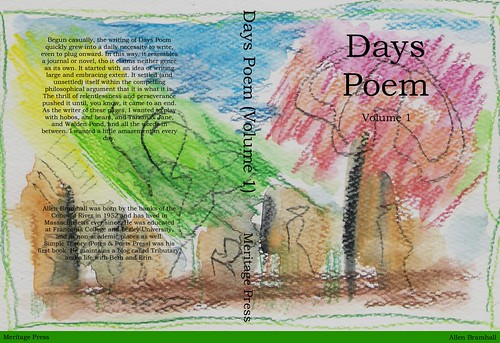
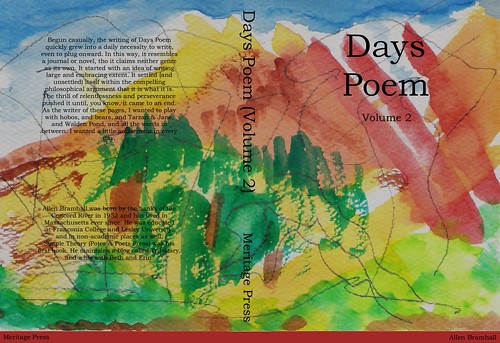
Sunday, March 18, 2007
Erin's finishing up the cover designs for Days Poem, volumes 1 and 2 (and that's all the volumes there are or will be). I did the art but don't know enough about Photoshop (or in this case, its freeware, open source substitute, The Gimp) to get text on. the covers look great, very colourful. Beth long ago had the idea of using a painting she saw, of men on a raft going down a river, a nicely apt image for the poem. we've been unable to find the specific painting. George Caleb Bingham has one that's close. rights issues, of course, are involved as well. so I'm happy to use my own work. and it's nice having Erin's effort involved. I will post the 2 images when Erin finishes, because I think they look awesome and I'm excited about the book. save your nickels.
saw not one but 2 George Hamilton movies: Love at First Bite and Zorro the Gay Blade. we actually went to Barnes and Noble in search for Apocalypto. reviews of which I haven't seen, but it being set in pre-Colombian Central America and my having seen the trailers, it looks engaging. yes, I realize Mel Gibson can go over the top. the dvd is not available till may, but Beth saw the 2 Hamilton movies, of which she had fond recollection. LAFB was the lesser movie. Hamilton plays Dracula, who comes to NYC to secure the affection of Susan St James. Hamilton's good-natured, somewhat preening acceptance of his roles is a transmogrification of corny. it doesn't come across as hammy because he's having so much fun. I particularly enjoyed Richard Benjamin, who took his usual earnest neurotic and added a fun squirrelly touch. the movie seemed dated for several reasons. the iconic disco era stuff, like the de rigueur disco scene itself, were included to highlight the movie's freshness. not so fresh now. likewise all the current stars, like Susan St James and Arte Johnson (who was pretty good, actually), as well as the cameos by Sherman Hemsley and Isabelle Sanford: these folk seem out of date now. Hamilton doesn't. Zorro The Gay Blade was much stronger. GH plays Zorro's son. his father bequeathed mask and cape to him and Hamilton takes over the duties. the other actors don't seem as dated, maybe because they are better at what they do. Ron Liebman as the evil alcalde gets to snap and shout thru out the movie. Hamilton enjoys playing with a broad barely fathomable accent. his Zorro sustains an injury, but luckily his long lost brother shows up to take over duties. this is Hamilton as well. he's flamboyantly poncy and just plain silly. he eschews the black costume for various colourful, fringed and beaded substitutes. Kasey Mohammad writes on his blog about how disappointing his recent viewing of Blazing Saddles was. je connais. a lot of movies, especially comedies I think, hold up poorly over time. partly, it is because the performers aren't able to get out of the era. I mean, Susan St James simply doesn't arise above the late 70s and 80s. she's a worm hole back to then. so is Richard Benjamin, but at least there's a tweak to his role that provided a revivifying flair. there was a Mel Brooks collection available at B&N. I've seen 4 of the 6 movies and have no inclination to see any again. even tho I thought the films were mostly really funny. their edge has dulled, their freshness dissipated. there's a bit of Shakespearian gender juggling in Zorro, with the Gay Blade dressed as a woman fending off the alcalde and dressed as Zorro fending off Lauren Hutton. both brothers enter the realm of mock heroic. anyway, both movies are pleasantly cute and Zorro holds up quite well.
Saturday, March 17, 2007
watched Nacho Libre last night. an odd movie. it's a Jack Black star vehicle, obviously. I don't think I've seen a Black movie previously tho it seems like I'm pretty familiar with him. he reminds me of Belushi but I have to say I also thought of Lou Costello last night, too. Costello being more innocent. Belushi's physical comedy is pretty plangent. I occasionally laugh but more often feel oppressed. Black has a lighter touch. people have spoken well of Nacho Libre but I found myself distracted by its normative impulses. are we supposed to buy this guy as a priest? perhaps it shouldn't matter but the pieties are fake yet at times dwelt upon. it doesn't hold up. the idea of this priest as a wrestler is rather sweet and it works. but when he becomes coarse it twists things out of shape. I liked the evocation of Mexican wrestling. I have to admit I've never seen one of those films in which masked wrestlers go about the world fighting crime. they sound so weird as to be pure, like how old time wrestling had a purity that Vince McMahon's empire savvy has completely crushed. the movie's narrative is straightforward but presented choppily, the scenes being more like set pieces. the movie's odd visual reality was nice. I just found myself trying to compute what perhaps I hadn't ought to compute. Nacho was hot for the nun at 1st sight, but sweet for her as well. there's a scene in which she's in her room wearing a diaphanous nightgown and doing her hair, typical nun stuff. Nacho shows up and they comically and chastely eat toast together. just hard to get a grip on intentions here, filmmaking wise. at the end it is all too obvious. Nacho must fight and defeat the great wrestler, and it is no better than Rocky. altho what inspires him to victory is the sight of one of the orphans wearing a wrestling mask. from there it is Moe, Larry the cheese, righteous victory for the underdog. another movie came to mind as being more successful. Three Amigos. yes, a Lorne Michaels movie, but still. Steve Martin and Chevy Chase were still at the height of their smug insincerity, so the normative bullshit never had a chance. them and Martin Short bounced off each other nicely. some surreal moments added to the effect, like the desert scene where critters sing. Nacho Libre wasn't surreal but it tended toward a pleasant oddity. at the end, of course, the orphans are saved. Nacho and the nun are still of the cloth but the carnal element has not gone away. I liked how comfortably the movie went and 'did' Mexico. nothing of the Hollywood soundstage here, nor any imports except for Jack himself. that's how to do a low budget.
Subscribe to:
Posts (Atom)